Crochet Double Sole for Baby Booties: Free Pattern & Tutorial – 5 Sizes
A well-shaped sole can completely change the look of handmade baby shoes.
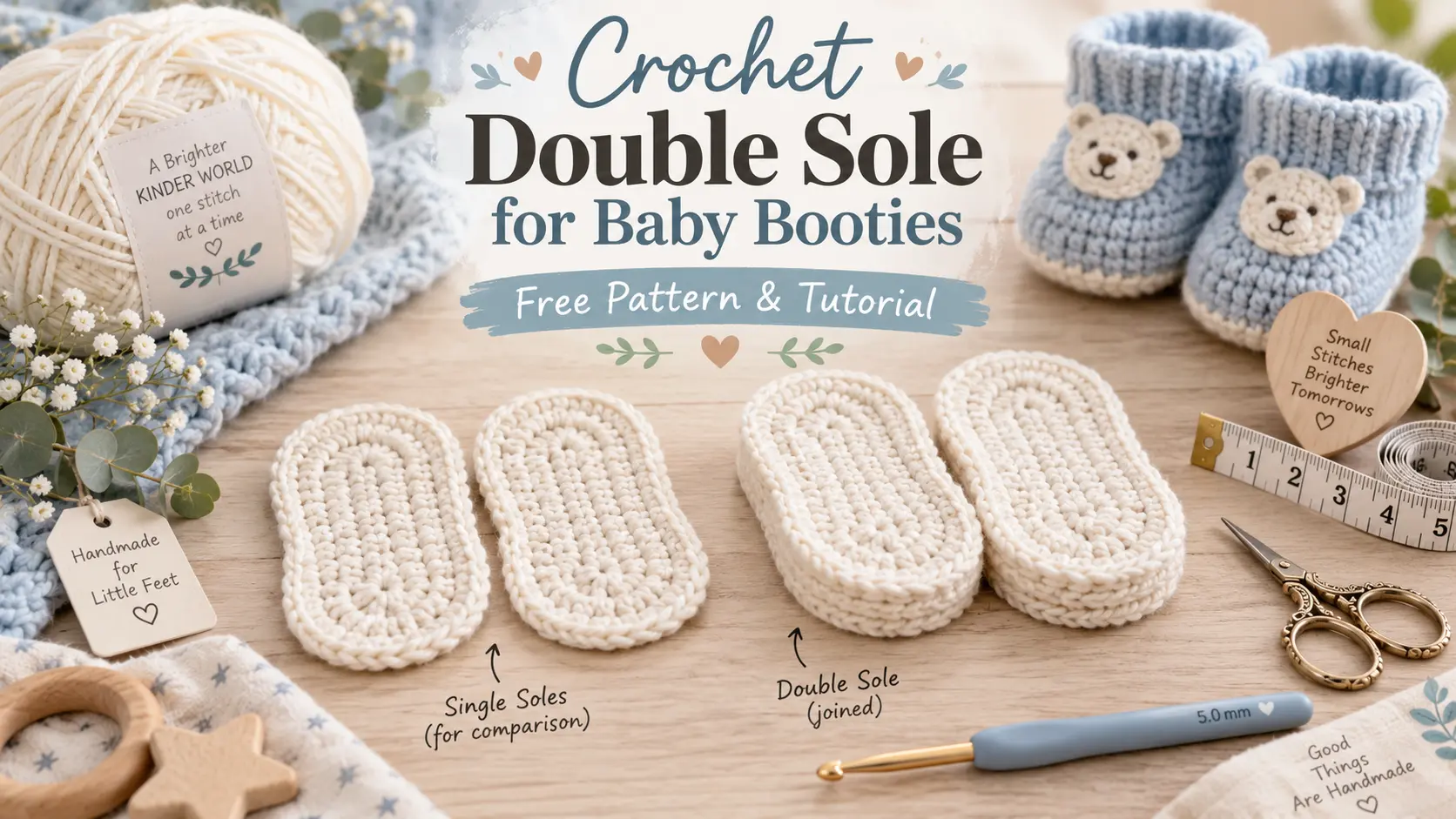
If your crochet booties tend to feel too soft or lose their shape easily, adding a crochet double sole for baby booties creates a thicker, more defined base while keeping the shoes soft and flexible.
In this tutorial, you’ll learn how to crochet an original double sole in five baby sizes, from newborn to 12 months. You’ll make two matching sole pieces for each shoe, then join them together before adding the upper.
This technique is especially useful for crochet sneakers, Mary Jane shoes, loafers and structured baby booties.
Why Make a Crochet Double Sole for Baby Booties?
A traditional baby bootie often uses only one crocheted sole.
For very soft slippers, that’s usually enough.
But when you want your crochet baby shoes to look more structured, using two sole layers can help create:
- a thicker base;
- a cleaner edge;
- better shape retention;
- a more sneaker-like appearance;
- extra definition between the sole and upper.
A double sole also gives you more opportunities to play with contrasting colors.
A white sole paired with a blue, pink, beige or green upper can immediately make a crochet shoe look more polished.
Crochet Double Sole Pattern at a Glance
Skill level: Advanced beginner
Terminology: US crochet terms
Yarn: #3 Light / DK cotton or cotton blend
Hook: 3 mm
Construction: 4 individual soles joined into 2 double soles
Sizes: Newborn to 12 months
Method: Worked in continuous oval-shaped rounds around a foundation chain
Important Sizing Note
Baby sizing varies considerably.
Use the age ranges below as a starting point, but choose your size primarily by the finished sole measurement.
If you’re unsure which length you need, check our Crochet Baby Shoe Size Chart: Newborn to 12 Months before starting.
Baby Booties Sole Sizes
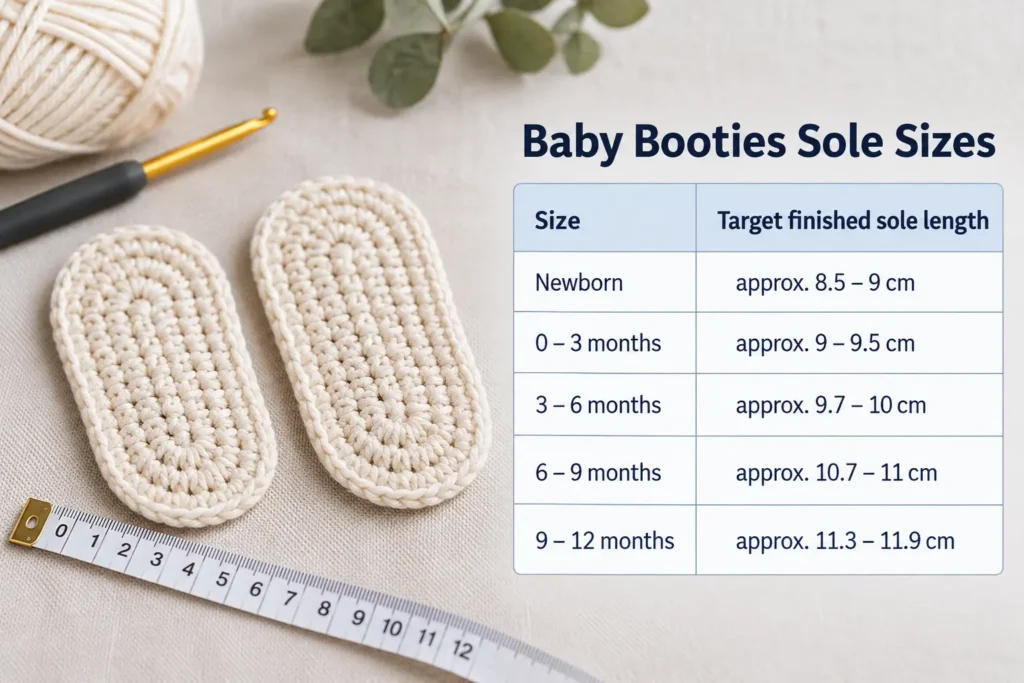
These finished measurements are more useful than age alone.
Always measure the baby’s foot when possible and compare it with your finished crochet sole.
Materials
You’ll need:
- #3 Light / DK cotton or cotton-blend yarn;
- 3 mm crochet hook;
- stitch markers;
- scissors;
- tapestry needle;
- measuring tape.
You can use one color for the entire sole or make the joining edge in a contrasting shade.
For sneaker-style booties, white or cream works particularly well for the sole.
Crochet Abbreviations
ch – chain
sc – single crochet
inc – work 2 sc in the same stitch
sl st – slip stitch
st(s) – stitch(es)
rep – repeat
The beginning chain does not count as a stitch.
Free Crochet Double Sole for Baby Booties Pattern
Make 4 individual sole pieces.
Two matching pieces will be joined together for each shoe.
Pattern sizes are written:
Newborn (0–3 months, 3–6 months, 6–9 months, 9–12 months).
Foundation Chain
Ch:
12 (14, 16, 18, 20)
Round 1
Starting in the second chain from the hook:
Work 2 sc in the first ch.
Sc in the next:
9 (11, 13, 15, 17) ch.
Work 4 sc in the last chain.
Rotate your work so you can crochet along the unused loops on the opposite side of the foundation chain.
Sc in the next:
9 (11, 13, 15, 17) ch.
Work 2 sc in the remaining loop of the first chain.
Join with a sl st.
26 (30, 34, 38, 42) sts
Stitch Count Check
For Newborn:
2 + 9 + 4 + 9 + 2 = 26 stitches
Round 2
Ch 1.
Inc in each of the first 2 sts.
Sc in the next:
9 (11, 13, 15, 17) sts.
Inc in each of the next 4 sts.
Sc in the next:
9 (11, 13, 15, 17) sts.
Inc in each of the final 2 sts.
Join with a sl st.
34 (38, 42, 46, 50) sts
For the Newborn size:
4 + 9 + 8 + 9 + 4 = 34 stitches
Round 3
Ch 1.
Work:
(inc, sc) twice.
Sc in the next:
9 (11, 13, 15, 17) sts.
Work:
(inc, sc) 4 times.
Sc in the next:
9 (11, 13, 15, 17) sts.
Work:
(sc, inc) twice.
Join with a sl st.
42 (46, 50, 54, 58) sts
Fasten off.
For Newborn:
6 + 9 + 12 + 9 + 6 = 42 stitches
Complete Stitch Count Chart
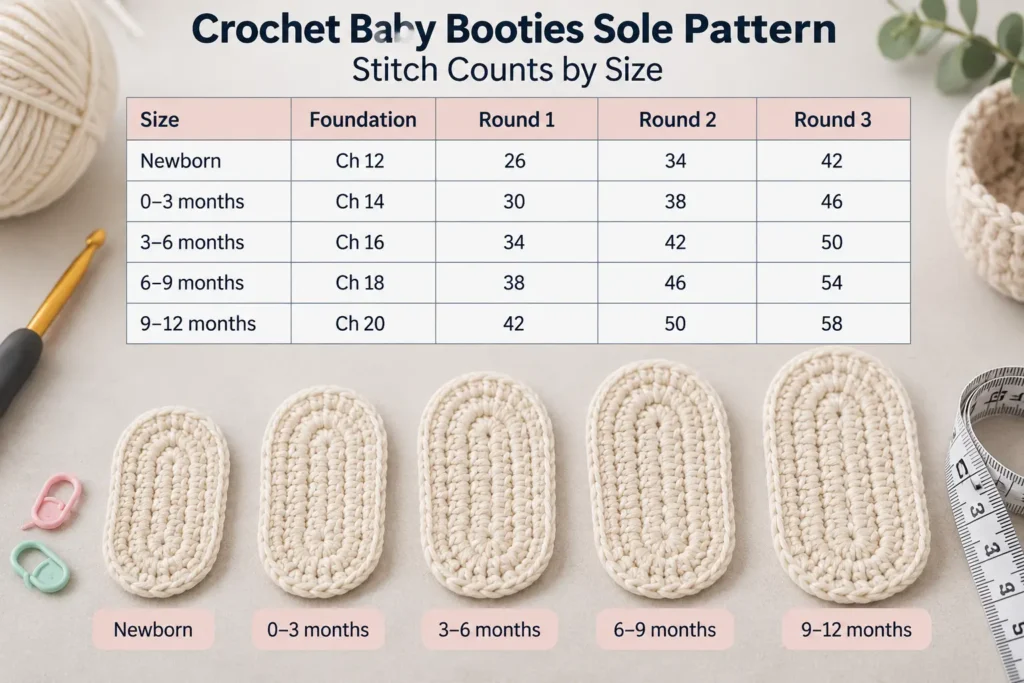
Measure Your Crochet Sole Before Continuing
This is one of the most important parts of the pattern.
Place your finished sole flat without stretching it.
Measure in a straight line from the center back of the heel to the furthest point of the toe.
Compare your measurement with the target size.
If the sole is too large, try using a slightly smaller hook or tighter tension.
If the sole is too small, try a slightly larger hook.
Don’t automatically add or remove stitches, because changing the stitch count can alter the shape of the heel and toe.
Make Four Matching Crochet Soles
Once you’re satisfied with the size of your first sole, repeat the pattern until you have:
4 individual crochet soles.
You’ll need:
2 soles for the left shoe
2 soles for the right shoe
Before joining them, lay all four pieces side by side.
Compare their:
- length;
- width;
- heel shape;
- toe shape.
Pair the two most similar soles together.
How to Join a Crochet Double Sole
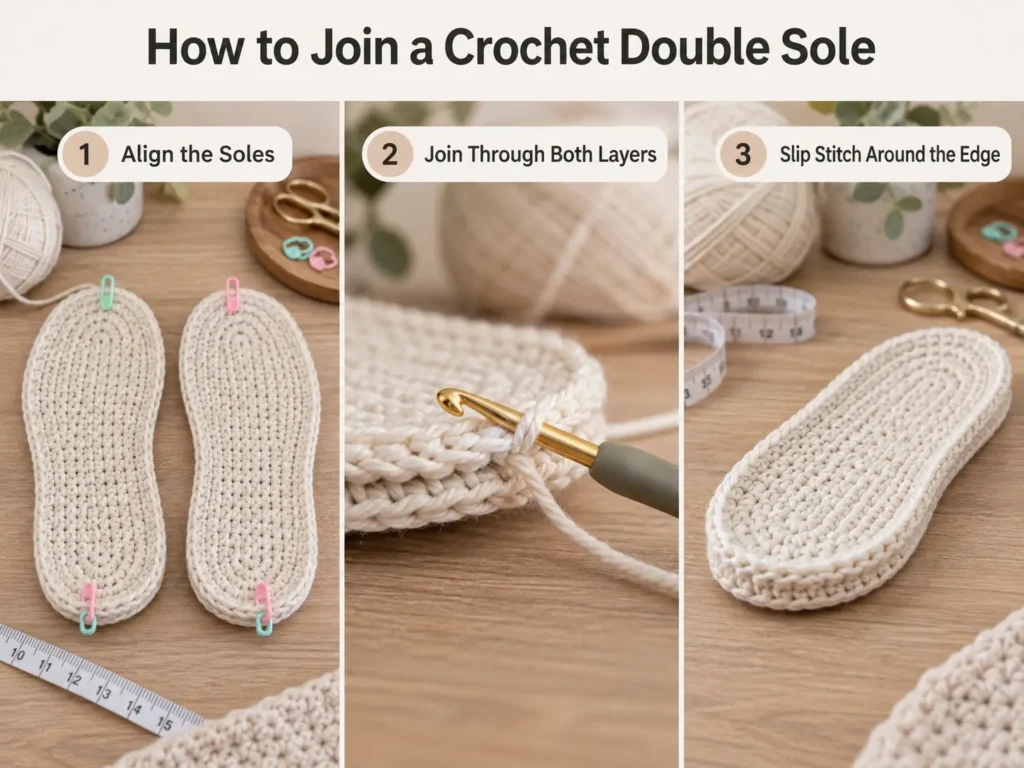
Now we turn the individual pieces into the crochet double sole for baby booties.
Step 1: Align the Two Soles
Place two matching sole pieces together.
Keep the cleaner sides facing outward and align the wrong sides toward each other.
Make sure:
heel matches heel, toe matches toe and side stitches line up.
Adding stitch markers at the heel, toe and sides can prevent the layers from shifting while you crochet.
Step 2: Join Both Layers
Insert your crochet hook through the corresponding edge stitch of both sole pieces.
Join your yarn.
Ch 1.
Work 1 sl st through both layers in every stitch around.
Continue until you return to the starting point.
Join and fasten off.
Your first double sole is complete.
Repeat for the second shoe.
Keep Your Joining Tension Relaxed
Avoid pulling the slip stitches too tightly.
If your joining round becomes too tight, the sole may begin to curl or shrink around the edge.
You want the two pieces securely joined without compressing the oval shape.
After joining, place the double sole flat and check it again.
Slip Stitch vs. Single Crochet Join
You can also join the two sole layers with single crochet.
The two techniques create noticeably different finishes.
Slip Stitch Join
A slip-stitch join creates a:
- flatter edge;
- thinner border;
- subtle finish;
- clean sneaker-style appearance.
Single Crochet Join
Single crochet creates a:
- thicker border;
- more visible edge;
- slightly more decorative finish.
For a structured crochet sneaker, I usually prefer the flatter appearance of the slip-stitch join.
For a decorative baby bootie, the single crochet edge can look beautiful too.
Why Is My Crochet Double Sole Curling?
A little movement around the edge isn’t unusual.
Heavy curling, however, usually means something needs adjusting.
One possibility is that the joining stitches are too tight.
Another is that the two soles aren’t actually the same size.
Trying to force a larger sole to line up with a smaller one can create puckering.
Before joining, lay both pieces flat and check that their stitches naturally align.
My Two Crochet Soles Aren’t the Same Size
This usually comes down to tension.
Even with identical stitch counts, one sole can become longer or wider if your tension changes.
The yarn can also make a difference.
To keep your crochet double sole for baby booties consistent:
- use the same yarn for all four soles;
- use the same hook;
- measure each piece immediately after finishing;
- compare soles before joining;
- avoid stretching one piece to fit another.
Can I Use Different Colors?
Absolutely.
A contrasting edge can make the sole part of the overall design.
For example:
white sole + navy upper
cream sole + dusty pink upper
white sole + sage green upper
For baby sneakers, a contrasting sole often gives the strongest shoe-like appearance.
Can I Crochet the Shoe Upper Directly Onto the Double Sole?
Yes.
Once your double sole is joined, you can build the upper from its edge.
The exact method will depend on your baby shoe design.
Some patterns work directly into the joining stitches, while others use selected loops to create a crisp line between the sole and upper.
Want to see how a reinforced sole works in a sneaker-style project? Read our Crochet Baby Sneakers Pattern Guide next.
Is a Double Sole Better Than a Single Sole?
Not always.
A single sole is ideal for very soft, sock-like baby booties.
A double sole makes more sense when you want:
- greater structure;
- more visual definition;
- a thicker foundation;
- a sneaker-style finish.
Choose the construction that suits the final design.
Can I Put Cardboard or Plastic Between the Sole Layers?
For wearable baby booties, I recommend keeping the sole soft rather than inserting rigid materials.
A crochet double sole for baby booties already creates more structure without adding hard components.
Remember that crochet booties aren’t a replacement for properly designed outdoor walking shoes.
Is This Double Sole Suitable for Walking Babies?
A double crochet sole is still a soft yarn sole.
Adding another layer does not automatically make the booties supportive or non-slip.
This type of crochet footwear is most appropriate as soft baby footwear, decorative shoes or pre-walker booties.
Frequently Asked Questions
What is a crochet double sole for baby booties?
A crochet double sole for baby booties is made by crocheting two matching sole pieces for each shoe and joining them together around the edge.
The result is thicker and more structured than a single-layer crochet sole.
How many soles do I need for one pair of baby booties?
You’ll need four individual crochet soles.
Two pieces are joined for the left shoe and two for the right shoe.
What sizes are included in this crochet baby sole pattern?
This free pattern includes five sizes:
Newborn, 0–3 months, 3–6 months, 6–9 months and 9–12 months.
Because babies vary, always compare the finished sole measurement with the baby’s actual foot.
Our Crochet Baby Shoe Size Chart can help you choose the most appropriate length.
What yarn is best for a crochet double sole?
A #3 Light / DK cotton or cotton-blend yarn is a practical choice for this version.
Cotton gives the stitches good definition and helps the sole maintain a more structured appearance.
How do I join two crochet baby shoe soles?
Place two matching sole pieces together and work through the corresponding stitches of both layers.
A slip-stitch join creates a flatter edge, while single crochet creates a thicker decorative border.
Why is my finished sole larger than expected?
Yarn thickness, hook size and crochet tension can all change the finished dimensions.
That’s why measuring the actual sole is more reliable than relying entirely on the stitch count.
Can I use this pattern for crochet baby sneakers?
Yes.
The crochet double sole for baby booties is particularly useful for sneaker-style projects because the thicker base helps create a more structured shoe silhouette.
Check our Crochet Baby Sneakers Pattern Guide for more sneaker construction ideas.
Final Thoughts
Learning how to make a crochet double sole for baby booties gives you a useful foundation for many different baby footwear projects.
The technique itself is simple: make two identical soles, check the finished measurements, align the layers carefully and join them without pulling the edge too tightly.
Once you’ve mastered the double sole, you can build crochet sneakers, booties, loafers and other soft baby shoe styles on top of it.
📌 Love this pattern? Save it on Pinterest so you can easily return to the stitch counts, sizing chart and joining instructions when you’re ready to crochet your next pair.