Easy Crochet Baby Shoe Size Chart: Newborn to 12 Months
Getting the size right is one of the most important parts of crocheting baby shoes.
A beautiful pair of booties can have perfect stitches and neat finishing, but if the sole is too short, too long or too narrow, the finished project may not fit comfortably.
That is why this crochet baby shoe size chart focuses first on the baby’s actual foot measurement and uses age only as a secondary guide.
Baby shoe charts can vary considerably between brands and crochet patterns, so whenever you have access to the baby, measure the foot before choosing a size. Foot length is a more reliable sizing reference than age alone.
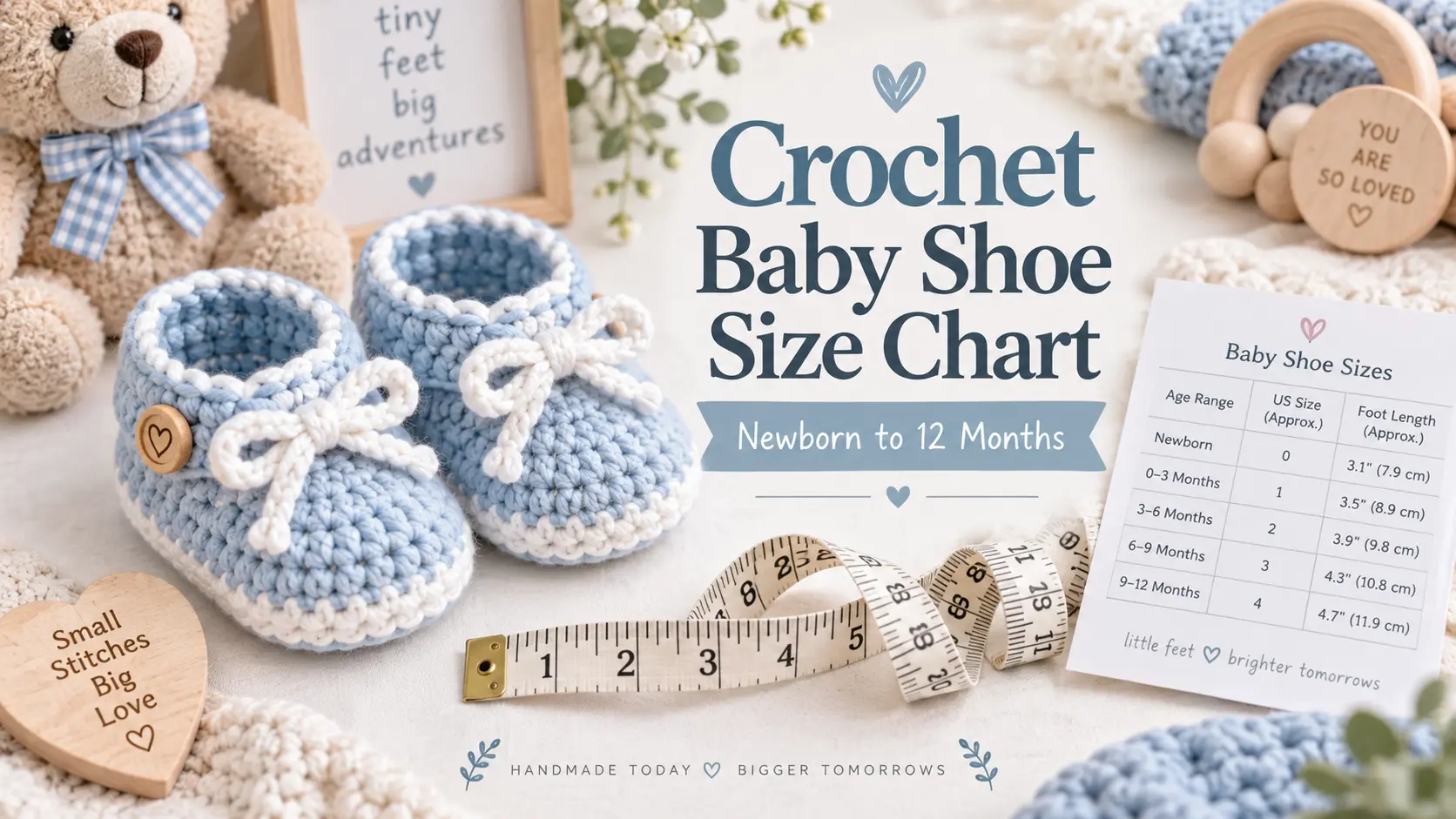
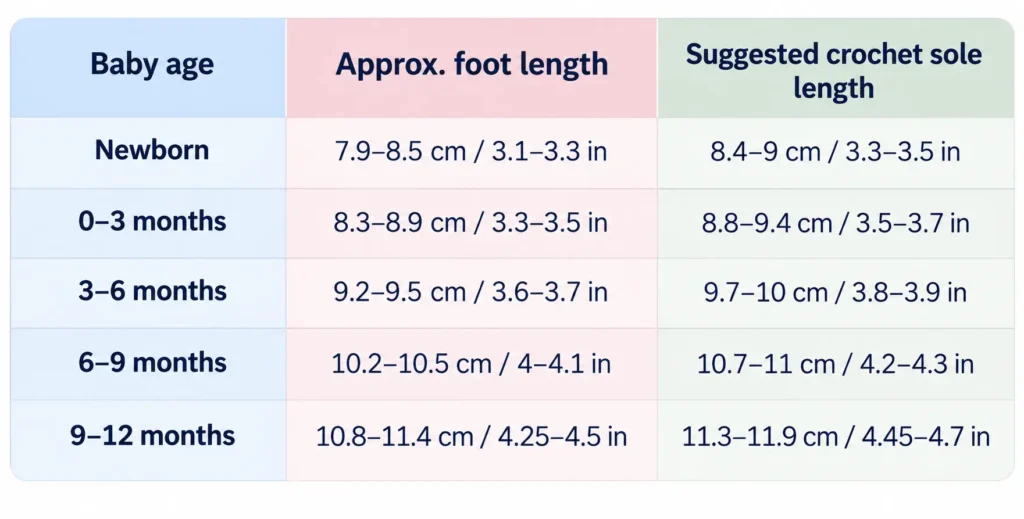
Crochet Baby Shoe Size Chart
Use the following chart as a practical starting point for soft crochet booties and baby shoes.
Important
These are approximate measurements, not guaranteed sizes.
Babies grow at different rates, and published baby shoe charts do not all use exactly the same age-to-length ranges. Always use an actual foot measurement when possible.
The suggested crochet sole length above allows approximately 0.5 cm / 0.2 in of additional room beyond the measured foot length. For soft infant and pre-walker footwear, around 0.5 cm of room is commonly recommended as a practical allowance. (The Kids Land Shoes)
How to Measure a Baby’s Foot for Crochet Shoes
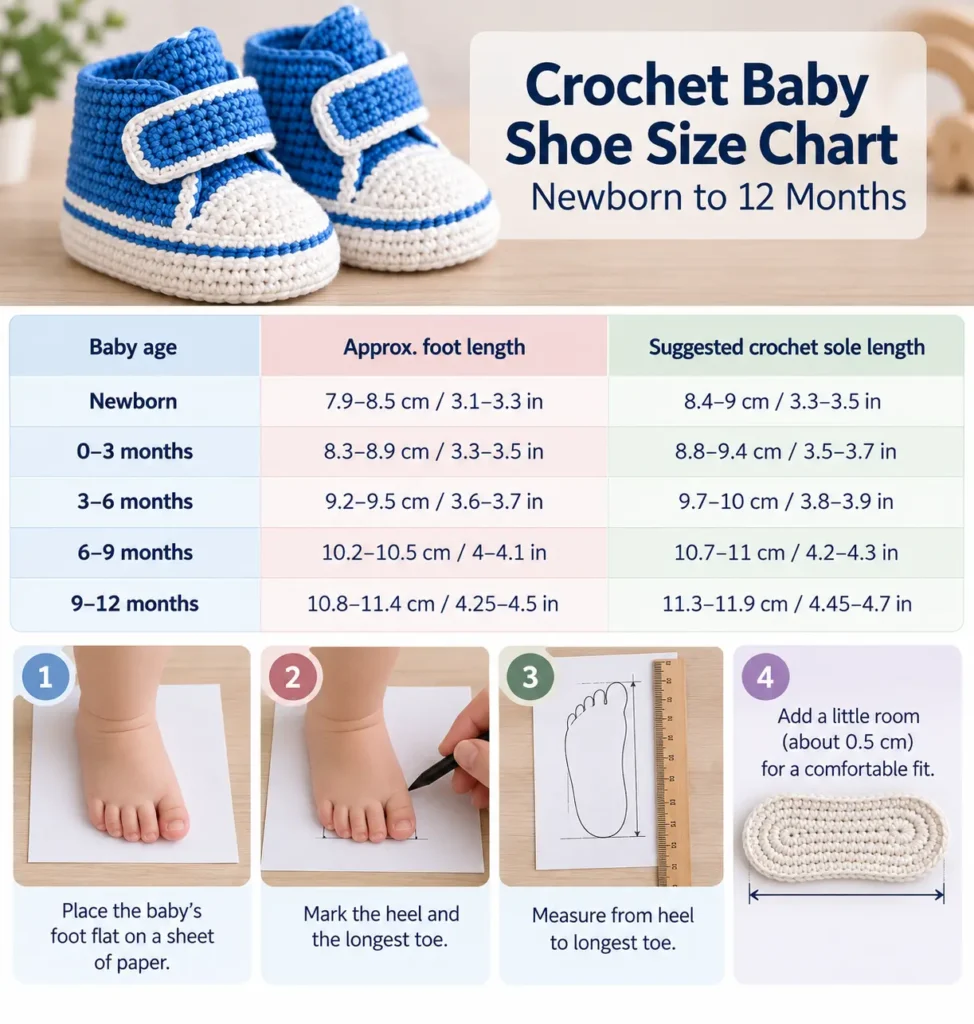
You don’t need any special equipment.
You’ll need:
- a ruler or measuring tape;
- a piece of paper;
- a pencil;
- the baby’s bare foot.
Step 1: Position the foot
Gently place the baby’s bare foot flat.
If the baby can stand comfortably, measure while the foot is bearing weight. For a younger baby, gently flatten the foot without forcing the toes.
Step 2: Find the heel and longest toe
Measure from the very back of the heel to the end of the longest toe.
Don’t automatically assume the big toe is the longest.
Step 3: Measure both feet
Measure the left and right foot.
It is normal for one foot to be slightly longer than the other, so use the larger measurement when sizing the crochet shoes. This is also standard advice in children’s footwear measurement guides. (The Kids Land Shoes)
Step 4: Add a little room
For soft crochet baby booties, a useful starting point is:
Measured foot length + approximately 0.5 cm = target inner sole length
For example:
If the baby’s foot measures 9.2 cm, aim for an inside shoe length of approximately:
9.2 cm + 0.5 cm = 9.7 cm
That small amount of space gives the toes some room without making a soft bootie excessively loose.
Foot Length vs. Sole Length: What’s the Difference?
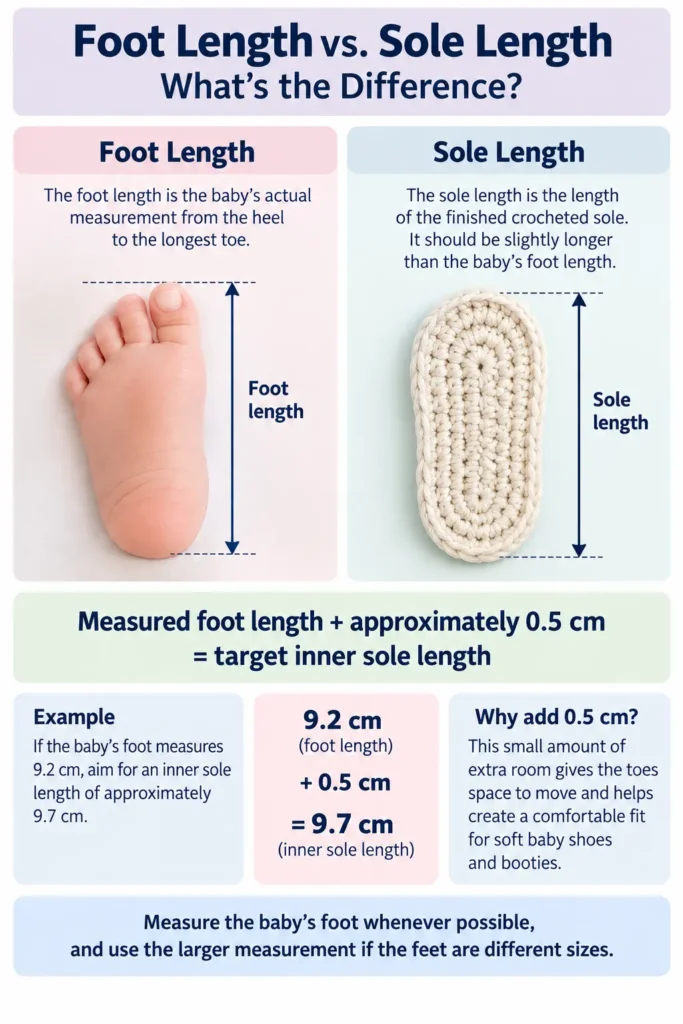
This distinction causes a lot of confusion in crochet patterns.
Foot length
The foot length is the baby’s actual measurement from heel to longest toe.
Sole length
The sole length is the length of the finished crocheted sole.
They should not automatically be identical.
If a baby’s foot measures exactly 10 cm and you make a crochet shoe with only 10 cm of usable interior space, the finished bootie may feel too snug.
For soft baby footwear, the crochet sole generally needs a small amount of additional room.
That is why our crochet baby shoe size chart separates the two measurements.
Why Age Alone Isn’t Enough
“0–3 months” sounds like a precise size.
It isn’t.
Age-based sizing is useful when you’re making a baby shower gift and cannot measure the baby’s foot, but it should be treated as an approximation.
For example, one published infant shoe chart places 0–3-month feet around 8.3–8.9 cm, while other crochet sizing resources use larger finished sole measurements for the same general age group.
That doesn’t necessarily mean one chart is “wrong.”
They may be measuring different things:
- actual foot length;
- inside shoe length;
- finished outsole;
- recommended size with growing room;
- or a specific pattern’s finished dimensions.
When following any crochet baby shoe pattern, check exactly what the designer means by “length.”
How Much Extra Room Should Crochet Baby Shoes Have?
For the soft, decorative baby booties we are discussing here, I recommend starting with approximately:
0.5 cm / 0.2 in of positive ease
That means:
8.5 cm foot → about 9 cm inner shoe length
9.5 cm foot → about 10 cm inner shoe length
10.5 cm foot → about 11 cm inner shoe length
This isn’t a universal rule for every type of children’s footwear.
Walking shoes have different fit, support and growing-room requirements. Some children’s footwear specialists recommend more space depending on the child’s age and shoe construction. (PubMed Central (PMC))
For our crochet blog, we’re talking primarily about soft crochet baby shoes and pre-walker booties, not protective outdoor walking shoes.
How Crochet Gauge Changes Baby Shoe Size
The size written in a crochet pattern is only accurate when your gauge is reasonably close to the designer’s gauge.
Suppose two crocheters follow exactly the same sole instructions.
One crochets tightly.
The other crochets loosely.
Their stitch counts can be identical while their finished soles are different lengths.
That’s why measuring the sole while you work is more useful than relying entirely on stitch count.
If your crochet sole is too small
You can try:
- slightly loosening your tension;
- using a larger crochet hook;
- checking that you’re using the correct yarn weight.
If your crochet sole is too large
Try:
- crocheting slightly tighter;
- using a smaller hook;
- verifying your yarn thickness.
Don’t automatically add or remove random stitches from a pattern unless you understand how those changes will affect the toe and heel shaping.
What Size Should I Crochet for a Baby Shower Gift?
This is harder because you probably can’t measure the baby’s foot.
Use age as your guide, but think about when the baby will actually wear the gift.
If you’re crocheting for a newborn who hasn’t arrived yet, a slightly larger 0–3 or 3–6 month pair may sometimes be more practical than a very small newborn size.
Babies’ feet grow quickly, which is another reason age charts should be used as guides rather than exact measurements. Research and children’s footwear guidance both emphasize frequent fit checks during early childhood.
You could also attach a small handmade tag stating the approximate inner sole measurement.
For example:
Handmade size: approx. 10 cm inner length
That’s often more useful than simply writing “3–6 months.”
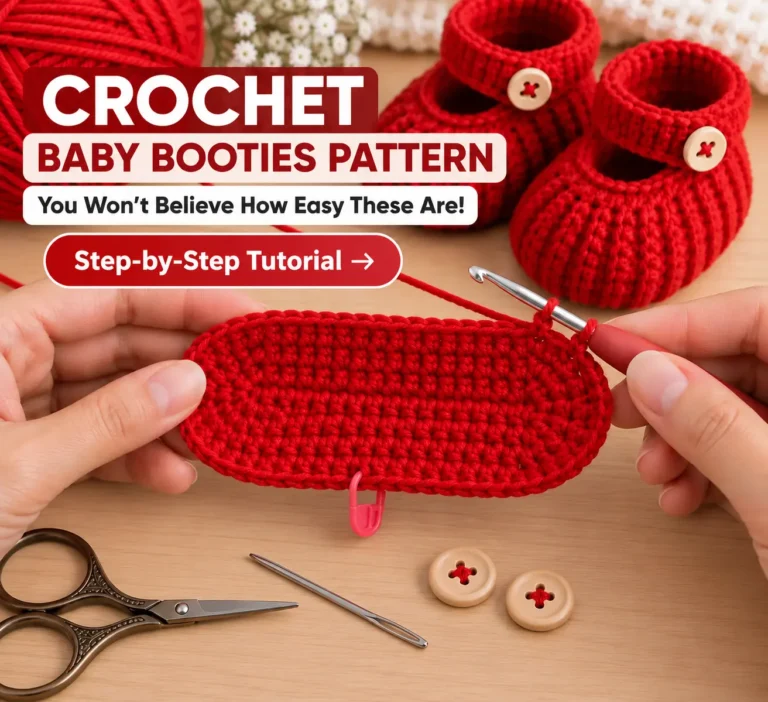
How to Measure a Finished Crochet Sole
Once your sole is complete, lay it flat without stretching it.
Measure in a straight line:
from the center back of the heel to the farthest point of the toe.
Don’t follow the curved outer edge with your measuring tape.
You’re measuring length, not perimeter.
If you’re making two shoes, compare both soles before moving on to the upper.
They should match as closely as possible.
This simple check can save you from completing an entire pair only to discover that one shoe is noticeably larger than the other.
Sizing Crochet Sneakers vs. Crochet Booties
The same basic foot measurements can be used for both, but construction matters.
A flexible sock-style bootie can accommodate a little variation because the fabric stretches.
A structured crochet sneaker with:
- a thick sole;
- dense stitches;
- reinforced sides;
- a shaped toe;
will generally have less stretch.
For structured designs, checking your finished sole measurement becomes especially important.
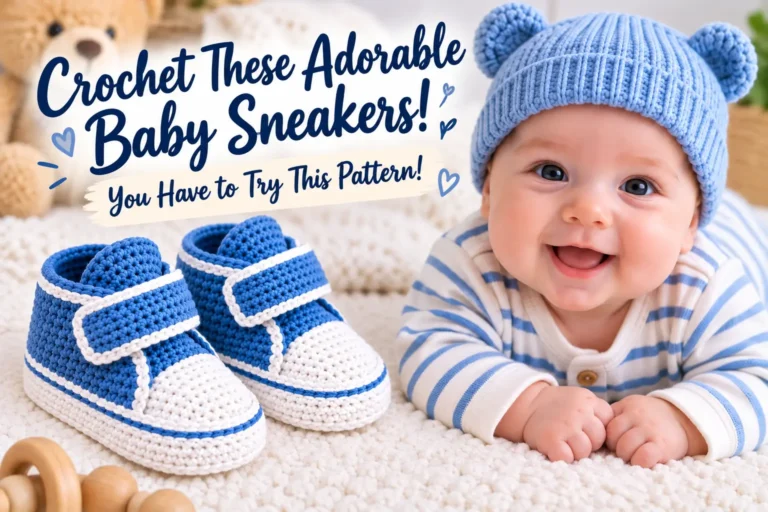
If you’re planning to crochet a sneaker-style project, take a look at our Crochet Baby Sneakers Pattern Guide, where we explain the construction, sizing, double sole, tongue and adjustable closure in more detail.
Crochet Baby Shoe Sizing Checklist
Before starting your baby shoes, remember:
- Measure heel to longest toe.
- Measure both feet.
- Use the larger measurement.
- Treat age as an approximate guide.
- Add a small amount of positive ease for soft crochet shoes.
- Check your gauge.
- Measure the crochet sole before continuing.
- Compare both shoes throughout the project.
- Recheck the fit as the baby grows.
Following those few steps will give you much more reliable results than choosing a size by age alone.
Frequently Asked Questions
What is the average newborn foot length on a crochet baby shoe size chart?
A newborn foot is commonly around 8 cm / 3.1 in, although every baby is different. Our crochet baby shoe size chart uses approximately 7.9–8.5 cm / 3.1–3.3 in as a practical reference range for newborns.
Whenever possible, measure the baby’s actual foot from the heel to the longest toe before choosing your crochet size.
What size crochet booties should I make for a 3-month-old?
For a baby around 0–3 months, our crochet baby shoe size chart uses an approximate foot length of 8.3–8.9 cm / 3.3–3.5 in.
Age should only be used as a general guide. If you can measure the baby’s foot, use that measurement instead because babies of the same age can have different foot sizes.
How much bigger should a crochet sole be than the baby’s foot?
For soft, pre-walker crochet baby shoes, adding approximately 0.5 cm / 0.2 in to the measured foot length is a useful starting point.
For example, if the baby’s foot measures 9 cm, you could aim for an inner crochet shoe length of approximately 9.5 cm. This is why our crochet baby shoe size chart shows both foot length and suggested crochet sole length separately.
The exact amount of extra room can vary depending on the yarn, stitch pattern and stretch of the finished shoe.
Should I measure the baby’s foot or an existing shoe?
Measure the baby’s actual bare foot whenever possible.
An existing shoe may already include growing room, padding or a thicker sole, so measuring it can give you a misleading result. The measurements in this crochet baby shoe size chart are designed to be compared with the baby’s heel-to-toe foot length.
For the most accurate fit, measure both feet and use the larger measurement.
Why is my crochet baby shoe larger than the size chart?
Gauge is usually the first thing to check.
Even when you follow the same stitch count shown in a pattern, thicker yarn, a larger crochet hook or looser tension can produce a longer sole.
If your finished measurements don’t match the crochet baby shoe size chart, measure your sole before continuing with the upper and adjust your hook size or tension if necessary.
Don’t rely only on stitch count—the finished measurement is what determines the actual size.
Can I use the crochet baby shoe size chart for sneakers and booties?
Yes. You can use this crochet baby shoe size chart as a starting point for soft crochet booties, slippers and baby sneaker-style projects.
However, construction matters. A soft bootie may stretch more than a structured crochet sneaker with a reinforced sole, so always compare your finished sole measurement with the baby’s actual foot length.
If you’re making structured sneakers, you can also check our Crochet Baby Sneakers Pattern Guide for more information about sole construction, shaping and sizing.
Is this crochet baby shoe size chart exact?
No. A crochet baby shoe size chart should always be treated as a sizing guide rather than a guaranteed fit.
Age ranges such as newborn, 0–3 months or 6–9 months are useful when you cannot measure the baby, but actual foot length is much more reliable.
For the best result, measure from the heel to the longest toe, compare that number with the chart and check your finished crochet sole before completing the shoe.
How often should I check a baby’s shoe size?
Babies grow quickly, so don’t assume that a pair that fit previously will continue to fit for a long period.
Before making another pair, measure the baby’s foot again and return to this crochet baby shoe size chart to choose the most appropriate sole length.
Final Thoughts
A reliable pair of crochet baby shoes starts with one simple measurement: heel to longest toe.
Age labels such as newborn, 3–6 months or 9–12 months are convenient, but they should never be more important than the baby’s actual foot size.
Save this crochet baby shoe size chart whenever you’re making booties, sneakers or another tiny footwear project so you don’t have to guess your measurements each time.
And if you’re ready to turn those measurements into a more structured project, visit our Crochet Baby Sneakers Pattern Guide next.
📌 Save this chart on Pinterest to keep the newborn-to-12-month measurements handy for your next baby crochet project.